
Профспілка працівників освіти і науки України
Головна > eng-news > Ukraine – Germany Trade Union Exchange: Experience and Partnership for DevelopmentUkraine – Germany Trade Union Exchange: Experience and Partnership for Development
5 травня 2026
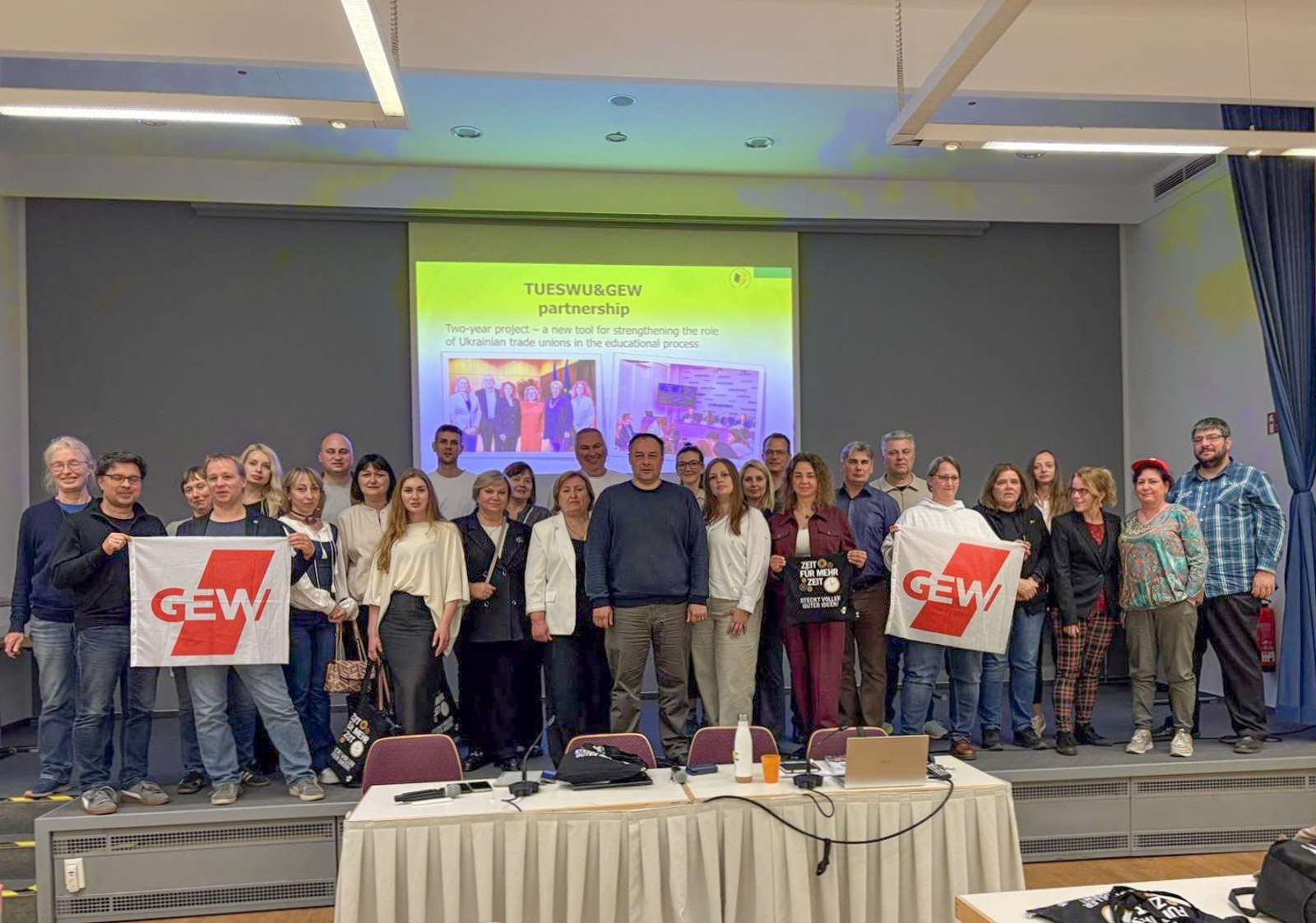 From April 12 to 18, 2026, an international trade union exchange took place in Frankfurt am Main and Mainz between the Trade Union of Education and Science Workers of Ukraine and the German Trade Union of Education (GEW).
The Ukrainian delegation’s visit was part of a long-term partnership project aimed at strengthening the institutional capacity of trade unions, enhancing the professional competencies of union representatives, developing social dialogue, and expanding the range of services for union members. The project was implemented with the support of the German Federal Ministry for Economic Cooperation and Development and with the assistance of SEQUA.
The Ukrainian trade union delegation included:
- Olha Chabaniuk – Vice President of the Trade Union (delegation leader);
- Dmytro Chomko – Vice President of the Trade Union, Head of the Trade Union Committee at Taras Shevchenko National University of Kyiv;
- Tetyana Zamorska – Head of the Donetsk Regional Organization of the Trade Union;
- Lyubov Korniychuk – Head of the Odesa Regional Organization of the Trade Union;
- Andriy Ivanchenko – Vice Rector for Scientific and Pedagogical Work at Zaporizhzhia Polytechnic National University;
- Oleksiy Lugina – Deputy Head of the Chernihiv Regional Organization of the Trade Union;
- Natalia Kuziv – Deputy Head of the Lviv Regional Organization of the Trade Union;
- Olena Gulko – Chair of the Zhmerynka City Organization of the Trade Union (Vinnytsia Oblast);
- Maria Davydova – Inspector for Information and Analytical Work at the Mykolaiv Regional Organization of the Trade Union;
- Vitalii Kindzerskyi – Chair of the Trade Union Committee of Faculty and Staff at Yurii Fedkovych Chernivtsi National University;
- Natalia Senkivska – Chair of the Youth Council of the Ternopil Regional Trade Union Organization;
- Viktoria Solominchuk – Legal Advisor of the Kyiv City Trade Union Organization.
Professional dialogues on trade union development and current challenges
The exchange program combined meetings with GEW representatives, study visits to educational institutions, joint practical sessions, and professional discussions on contemporary trade union practices.
The focus was on issues of trade union organizational development, training of trade union multipliers, representation of educators’ labor rights, as well as the search for effective solutions in response to current socio-economic challenges and the needs of Ukraine’s recovery.
The meetings with GEW leaders Tinna Mayor, Carmen Ludwig, Mathis Wilke, and Roman George provided valuable insights. They familiarized the Ukrainian delegation with the specifics of the German education system, the development of union membership, and modern approaches to engaging young educators and motivating them toward informed career choices.
As part of the event “Trade Union Work in Times of Crisis” with the participation of the GEW federal executive boards of Hesse and Rhineland-Palatinate, Olha Chabaniuk, Vice President of the Trade Union of Education and Science Workers of Ukraine, presented the union’s experience working under martial law and discussed the challenges and practical solutions aimed at supporting workers in the sector.
Each member of the Ukrainian delegation shared their own experience in trade union and educational work, informing their German colleagues about the activities of educational institutions and trade unions under wartime conditions, emphasizing that despite the extremely difficult circumstances of martial law, this work continues and is both important and possible thanks to professional resilience and solidarity. In particular, representatives of the Donetsk, Lviv, and Odesa regional organizations presented to their German colleagues the work of educational hubs created to support educators and internally displaced youth.
In his speech, DGB Frankfurt Executive Director Philipp Jexa emphasized the importance of developing cooperation between Frankfurt and the Lviv Regional Organization of the Trade Union of Education and Science Workers of Ukraine, which opens up new prospects for partnership.
A separate component of the program was an introduction to the structure, areas of activity, and corporate culture of GEW Rhineland-Palatinate, as well as a visit to the Brothers Grimm Elementary School in Ingelheim, which provided an opportunity to observe the organization of the educational process and practices of interaction in a German school. During their visits to educational institutions, participants also had the opportunity to speak with students and teachers who were forced to leave their homes and schools due to the war.
As part of the trade union exchange, a meeting was also held with representatives of the Hungarian trade union PDSZ, during which participants discussed experiences in protecting educators’ labor rights, trade union work in crisis conditions, the development of social dialogue, and the right to strike. This tripartite dialogue served as an important platform for exchanging best practices, fostering solidarity, and jointly seeking solutions to contemporary challenges.
Visits that broaden professional experience
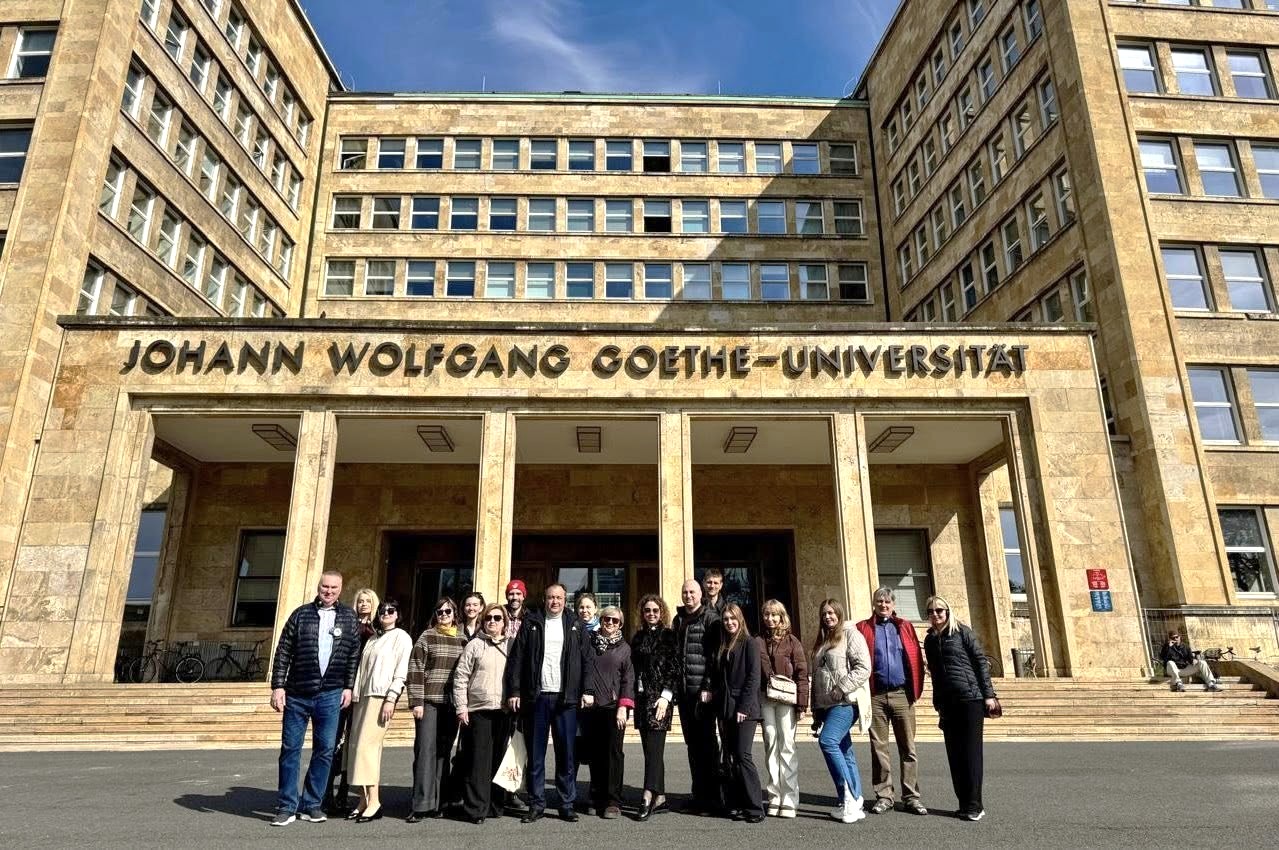
Among the participants’ most memorable experiences was a visit to Goethe University Frankfurt, which provided an opportunity to familiarize themselves with the university’s extensive infrastructure, the student environment, and the role of the union in protecting the rights of education workers.
“The union exchange with colleagues from GEW was an important professional experience and, at the same time, a demonstration of international solidarity, which is of particular significance in the context of war. Such meetings are not only about exchanging practices but also about support, partnership, and a joint search for solutions to protect education workers.
During the visit, we had the opportunity to familiarize ourselves with the work of German educational institutions, approaches to union activities, tools for representing workers’ rights, and the development of the educational environment. “This allows us to adopt useful experience, adapt progressive practices, and strengthen our own work,” – emphasized Olha Chabaniuk, thanking the German partners for their openness, support, and willingness to cooperate.
Delegation members note that the exchange was not only professionally beneficial but also an important demonstration of international solidarity and support for Ukraine.
They were particularly impressed by the openness of their German colleagues, their willingness to share experiences, strong trade union practices, and the opportunity to see how educational institutions and the trade union itself operate in Germany – all to adopt useful and progressive elements for the development of their own work.
The international trade union exchange was an important step in deepening international cooperation, strengthening partnerships, and developing new joint initiatives. After all, strong education begins with a protected teacher, and trade union solidarity today is not only support but also a joint investment in a peaceful future for Ukraine.
 From the feedback of participants in the international trade union exchange
Louise Brunner, GEW Hessen
I would like to sincerely thank my Ukrainian colleagues for the meeting in Frankfurt, for your openness, and for the time you devoted to us during the visit. You made a great impression on me, and your stories moved me.
It is particularly important for me to emphasize that international exchange is especially significant right now. I sincerely hope that circumstances will allow me to visit Ukraine in the near future.
Dmytro Chomko, Vice President of the Trade Union
Participating in the trade union exchange in Germany was a valuable professional and personal experience. Among the most memorable experiences was getting to know the university environment, particularly visiting one of the German universities – the Goethe-Institut – with its two large campuses, extensive student infrastructure, and genuine, rather than merely declarative, student participation in managing the space.
According to institute staff, approximately 28,000 students study here, mostly Germans. Tuition is free, though there is a mandatory semester fee of 400 euros. The institute has two large campuses: one for the social sciences and humanities in the city center and one for the natural sciences on the outskirts.
I was particularly struck by the number of students, their behavior, and the sense of “home” on campus. Part of the infrastructure is managed by the students themselves – not just formally, but in practice, “with their own hands.”
I was impressed by the university’s atmosphere, the number of students, the thoughtfulness of the learning and living environment, and the culture of academic life itself.
Special thanks for the meetings and conversations with colleagues from GEW. Above all – their attitude: constant support, openness, willingness to explain, support, and share experiences. This was deeply felt as a manifestation of true international solidarity, which is especially important for us during wartime.
Among the practices that sparked professional interest were the system of trade union mutual support – particularly the strike fund – the clear division of responsibilities among union members, and the ability of different unions to collaborate for the joint protection of workers’ rights. The creative approach of our German colleagues to organizing actions and union campaigns was also noteworthy.
Despite the differences between Ukrainian and German realities, such an exchange provides the most important thing – the opportunity to see other approaches, take what is useful for one’s work, and take a broader view of the role of trade unions today. The main conclusion is that professional ties must be nurtured and developed, because they are what expand opportunities.
Andriy Ivanchenko, Vice Rector for Scientific and Pedagogical Work at Zaporizhzhia Polytechnic National University
The trip was an inspiring and unifying experience that provided a wealth of impressions and hours of meaningful communication with colleagues. Exchanging experiences in organizing trade union work allowed for a deeper understanding of shared challenges and opportunities for development.
The visit to Goethe University in Frankfurt provided an opportunity to gain detailed insight into the role of the trade union in the university environment and the mechanisms for protecting the rights of education workers. The dialogue with representatives of GEW Hessen regarding effective tools for social dialogue, support for union members, and the digitalization of work with union activists proved particularly valuable.
The trip’s program provided an opportunity to discuss the challenges facing the Union’s work amid the war in Ukraine, as well as to establish useful contacts for future cooperation.
Tetyana Zamorska, Head of the Donetsk Regional Organization of the Union
The union exchange in Germany provided a valuable opportunity to learn from GEW’s experience, gain a deeper understanding of the mechanisms of social dialogue, the development of union membership, and modern approaches to protecting the rights of educators. Particularly useful were the meetings with colleagues in Hesse and Rhineland-Palatinate, which focused on trade union practices and the overall organization of the educational process.
An important part of the exchange was also the presentation of the Ukrainian trade union’s experience working under wartime conditions, particularly the activities of educational hubs and psychological support centers. I sincerely hope that this visit was another step toward strengthening international cooperation and the exchange of practices that can be useful for the development of the trade union movement in Ukraine.
Natalia Senkivska, Chair of the Youth Council of the Ternopil Regional Organization of the Trade Union
Visits to the IGS Herder and Realschule+Bingen Scharlachberg secondary schools were not just a fact-finding trip for our delegation, but a deeply emotional experience.
The experience of the Frankfurt school IGS Herder resonates remarkably with the values of the New Ukrainian School (NUS). Imagine: the morning here begins not with a strict bell, but with “compass time.” In classrooms named after precious stones, children gather in a circle to align their inner compass. This is a time for sincere conversations about what hurts or brings joy, and a time for planning the day together.
The Lernbüro format is particularly impressive. Here, the child is not a passive listener but the architect of their own learning. The ability to choose between subjects or working in the “quiet room” teaches the most important lesson: responsibility for one’s own freedom.
Here, the teacher acts not as a supervisor but as a wise mentor who steps in precisely when support is needed most. We were truly delighted to meet Ukrainian children here, whose smiles and calm confirmed that this school has become a place of strength and comfort for them.
The visit to the school touched us deeply. We witnessed the work of teachers in inclusive classrooms – on the true front lines of human empathy. Before us were children from all over the world who found themselves in an environment entirely new to them. It is hard to grasp just how exhausting and yet noble the work of educators is in a classroom where barely two students can communicate in a single language, yet every single one must be taught.
These children often feel lonely in a foreign world, and the school administration is doing everything possible to break down this wall of alienation. The involvement of volunteers helps young immigrants not only learn the language but also feel like part of the community. The school’s teaching staff has taken on a great mission: to see in every child a person who, above all, needs attention, sincerity, and trust. This is work that relies not on finances but on a huge heart.
This experience provided an opportunity to observe the flexibility of the German school system, modern approaches to organizing education, and practices that can be useful for professional reflection and development.
Olena Gulko, Chair of the Zhmerynka City Trade Union Organization
During the trade union exchange in Germany, gaining insight into the practices of organizing the educational process and the activities of the trade union as an influential social institution proved particularly valuable.
Among the interesting educational solutions were the so-called “compass lessons” at the Herder School in Frankfurt am Main, which combine daily planning, the development of student independence, and a digital detox. Also noteworthy were the interclass subject groups, practical career guidance training, and the school’s overall focus on responsibility and the development of soft skills.
Another important professional insight was the GEW’s experience in defending labor rights through collective bargaining agreements, where wage increases result from organized, united action. This once again confirmed the power of the union as a real tool for protecting workers.
Of particular interest was the German colleagues’ approach to union branding and communication – systematic work on organizational recognition, educational materials, and public presence.
The international dialogue with colleagues from Germany and Hungary was also valuable, offering an opportunity to compare approaches to protecting educators’ rights, social dialogue, and the role of trade unions in a democratic society.
The candid discussions about the work of Ukrainian trade unions in wartime and the genuine interest of colleagues in the situation in Ukraine left a strong impression. Particularly memorable were the meetings with Ukrainian children in German schools – a reminder of who we work for and why we do so every day.
Maria Davydova, Inspector of the Mykolaiv Regional Trade Union Organization
For me, this trade union exchange was not only an opportunity for professional dialogue but also a source of practical ideas for the further development of trade union work. The most valuable aspect was the lively communication with colleagues from GEW, as it was not just about presentations but also about how a strong and modern trade union is built day by day.
I was particularly impressed by the systematic approach of our German colleagues and the philosophy that a modern trade union combines humanity with technological expertise. The guiding principle of “Warum vor was” (why first, then what) was particularly interesting, as it emphasizes that working with people is based not only on formal requirements but on shared values, trust, and engagement. This is the approach that fosters not just membership, but a true community.
The experience with strategic communications and engaging activists was also valuable, where what matters is not mass participation but personal interaction, support, and working with people on the ground.
New approaches to organizing the educational environment also proved to be an important discovery. In particular, the practice of teachers working in teams, personalized learning, the genuine implementation of inclusion, and solutions aimed at reducing teacher burnout. This is an experience worth reflecting on and adapting.
Particularly valuable was the exchange with international partners regarding social dialogue, trade union solidarity, and the protection of education workers’ rights in crisis conditions. Initiatives to support Ukrainian children abroad made a special impression, providing a deeper understanding of the needs of our education families in wartime conditions.
After this visit, I was once again convinced that a modern trade union must not only respond to challenges but also set the agenda, act proactively, and be closer to the people. This is precisely the main value of the experience I witnessed.
Viktoria Solominchuk, Legal Advisor to the Kyiv City Organization of the Trade Union
For me, as a representative of the legal department, the most valuable part of the visit was learning about GEW’s human rights advocacy practices and approaches to protecting the labor rights of education workers in Germany.
The exchange of experiences regarding labor legislation, collective bargaining, representation of union members’ interests, and mechanisms for resolving collective labor disputes was of significant interest. Certain legal aid tools used by our German colleagues have practical potential for adaptation in our work.
I was particularly impressed by the institutional capacity of trade unions in Germany to influence social processes, the high level of trust in the trade union movement, and the meaningful participation of union representatives in shaping government decisions.
I am convinced that this exchange of experience will contribute to strengthening advocacy work and the protection of members’ rights, as well as to the development of further cooperation between trade unions in Ukraine and Germany.
International Department
Повернутися