Система оплати праці педагогів потребує комплексного оновлення
ISTP 2026: A Dialogue Between Governments and Unions on the Future of Education
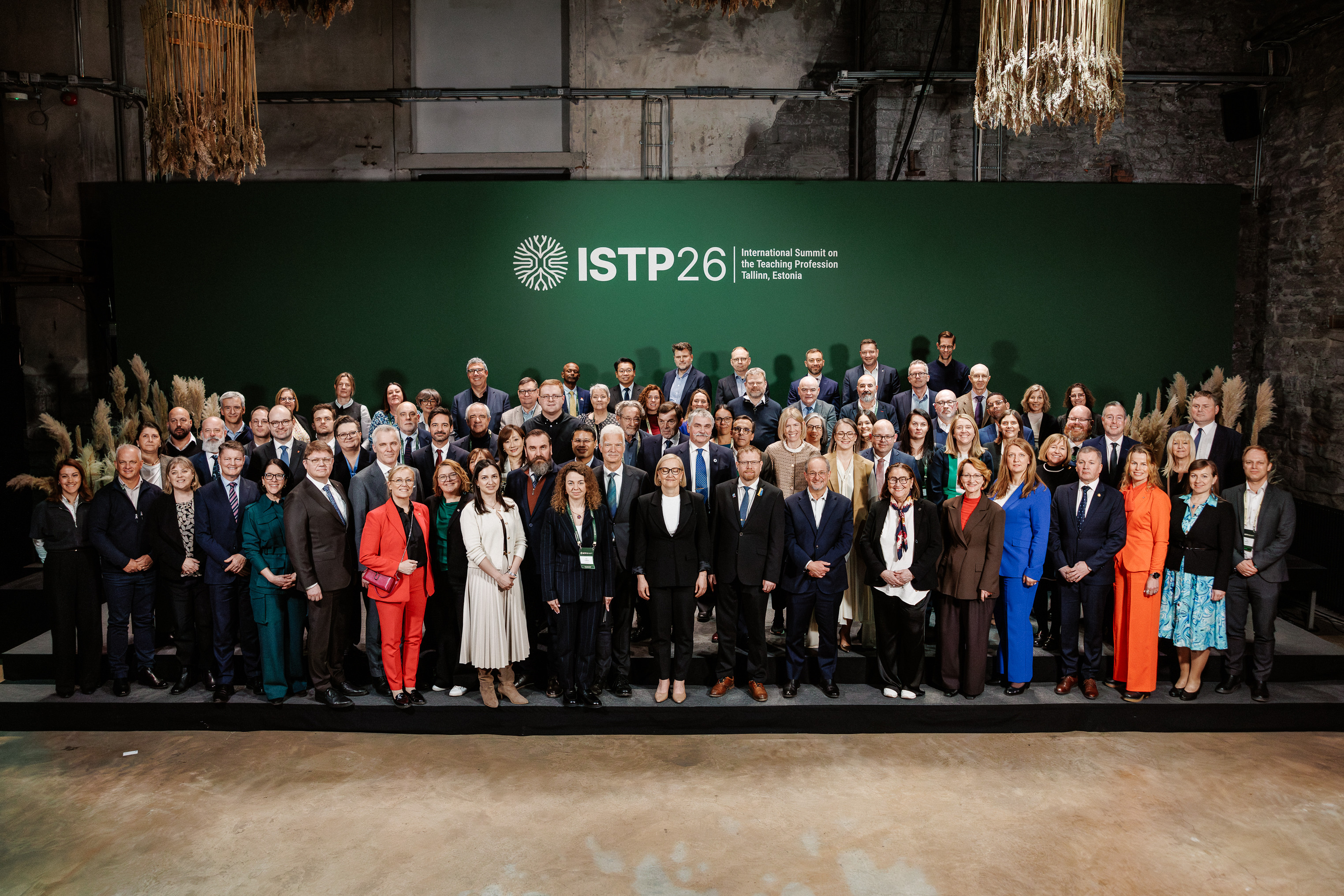
 The International Summit on the Teaching Profession (ISTP) 2026 took place on March 8-11, 2026, in Tallinn, Estonia. The event was attended by ministers of education and leaders of teachers’ unions from 20 countries around the world.
The summit was organized by the Government of Estonia, Education International, the Estonian Education Union, and the Organization for Economic Cooperation and Development.
This event traditionally serves as a platform for dialogue between governments, representatives of the teaching profession, and unions regarding the development of national education systems and the provision of quality education for all.
The main theme of the summit was “Switching gears: Teachers and Learners in the Future Learning Environment ”.
ISTP is a global platform for discussing the role of teachers in shaping education systems capable of responding to the challenges of the future. During the summit, participants discussed preparing teachers for new working conditions, changing professional requirements, and supporting education systems during a period of global uncertainty.
Education International General Secretary David Edwards noted that preparing teachers for the future requires developing the ability to adapt, think critically, collaborate, and exercise professional judgment in conditions of uncertainty. According to him, investing in these competencies is key to preparing teachers for the changes awaiting the education system.
Reemo Voltri, President of the Estonian Education Union, emphasized that hosting the summit in Tallinn is an important event for Estonia and for the teaching profession worldwide. He stressed that teachers’ voices must be taken into account when making decisions regarding education policy.
Ukrainian Delegation at ISTP 2026
The Ukrainian delegation, which included representatives of the Ministry of Education and Science of Ukraine led by Minister of Education and Science Oksen Lisovyi and the Trade Union of Education and Science Workers of Ukraine, participated in the ISTP 2026.
Among the summit delegates from the Union were Olha Chabaniuk, Vice President of the Trade Union of Education and Science Workers of Ukraine, and Kateryna Maliuta-Osauova, Head of International Department of the Trade Union.
Speaking at the summit, Olha Chabaniuk emphasized that the full-scale war is having a significant impact on Ukraine’s education system.
“The war is destroying schools and undermining the sense of stability and security. But autonomy gives teachers the ability to adapt, protect education, and support children. Today in Ukraine, teacher autonomy is no longer just professional freedom. It is what allows education to survive and continue to develop despite the war,” noted the Olha Chabaniuk.
During their stay in Estonia, the participants also visited a Ukrainian school in Tallinn.
“We would like to express our gratitude to the Estonian Ministry of Education for all the opportunities provided to our teachers here in Estonia and for the autonomy they enjoy. This allows our educators to feel at home and continue working in their profession,” emphasized Olha Chabaniuk.
An important outcome for Ukraine was the support of international partners in the further development of the teaching profession and the improvement of teachers’ working conditions.
In particular, an agreement was reached to organize an event in Ukraine – ISTP4Ukraine, which is intended to unite the international community around issues of supporting Ukrainian teachers, as well as to facilitate the engagement of additional expertise and partner assistance.
We are grateful to Education International and the Organization for Economic Cooperation and Development for the initiative to hold such an event in Ukraine.
 Key Findings of ISTP 2026
During the International Summit on the Teaching Profession (ISTP) 2026, education ministers and leaders of education unions discussed the key challenges facing education worldwide. The focus was on changing demands on the teaching profession and the problem of the global teacher shortage, which is increasingly affecting education systems in various countries.
Participants emphasized the need to ensure that every child has a qualified teacher and to preserve the teacher-student relationship as the foundation of a quality educational process.
Special attention was given to issues of teachers’ professional autonomy, the conditions under which they make professional decisions, as well as the role of professional communities and accountability systems that support the development of teaching practice.
The summit also discussed the opportunities and risks of using artificial intelligence and educational technologies. The discussion focused on how these tools can expand teachers’ capabilities while ensuring the safety and protection of students.
In her speech, Kateryna Maliuta-Osaulova, head of the Trade Union’s international department, noted that Ukrainian schools are operating under difficult conditions amid the war, and access to modern technologies remains uneven.
“Many schools still lack stable internet, the necessary devices, and sufficient training to use new technologies. At the same time, Ukrainian teachers often take on far more roles than their profession requires: they become psychologists, mentors, and a source of stability for their students,” she noted.
According to her, artificial intelligence cannot replace a teacher, but it can serve as a supportive tool: helping to save time, facilitate lesson preparation, and ensure the continuity of learning even under the most challenging conditions.
Education International General Secretary David Edwards emphasized that teachers’ ability to meet the challenges of the future depends directly on how well-funded and organized education systems are. Implementing the UN’s recommendations for building a strong and sustainable teaching profession remains a key factor in addressing the global shortage of teachers.
The summit emphasized the need to create decent working conditions for teachers: ensuring competitive salaries, stable employment, manageable workloads, high-quality initial training, and opportunities for continuous professional development. Trust in teachers’ professional autonomy and their participation in educational decision-making processes were also identified as key conditions.
The main conclusion of the summit is that educational change is possible only where there is genuine support for and trust in teachers. It is precisely the involvement of teachers in shaping educational policy, the creation of decent working conditions, and investment in the profession that form the foundation of sustainable and high-quality education systems.
International Department